
Before using AI trading, please understand how automated execution works, why your returns may differ from those of the lead trader, and the losses you may incur. AI trading does not protect your principal, guarantee returns, or guarantee that your trading results will match those of the lead trader.
1. What Is AI trading?
Stockcoin AI trading is an automated trading feature. After you select a lead trader, set your copy-trading parameters, and confirm activation, the system will attempt to execute corresponding trades based on eligible trading signals and the status of your account. Actions such as opening, increasing, or reducing positions may be executed without seeking your confirmation for each individual trade.
Automatically following a trader does not mean fully replicating that trader's account. Your actual positions, execution prices, leverage, margin usage, and final returns may differ from those of the lead trader. You should independently decide whether to participate, which lead trader to follow, and how much capital to allocate, based on your own circumstances.
2. Following a High-Performing Lead Trader Can Still Result in Losses
Digital asset prices can fluctuate sharply. Leverage in derivatives trading magnifies gains and losses relative to the margin posted. If the market moves against you, you may lose some or all of the funds exposed to the risks of your positions in a short period of time.
A lead trader's historical returns, win rate, ranking, and number of followers do not indicate future performance and are not a platform guarantee of that trader's ability or returns. The lead trader's experience, trading style, capital base, and risk tolerance may differ from yours, and their strategy may change while you follow them. Assess the trading horizon, drawdowns, position risks, and use of leverage rather than relying solely on short-term returns.
3. Why Your Returns May Differ from Those of the Lead Trader
Copied trades are executed independently in your account. Differences may arise from signal-processing time, market price movements, order-book depth, allocated capital, quantity precision, fees, or trades that fail to be copied. Even when the trading direction is the same and positions are closed at similar times, your profit amount, rate of return, and even whether the outcome is a profit or loss may differ from those of the lead trader.
Pay particular attention to position increases. If an order to increase a position is not filled, the unfilled quantity will not be included in your average entry price. A subsequent close by the lead trader will not make your historical execution prices match theirs. The simplified example below assumes USDT-settled linear contracts, with all short positions closed at 77,000 USDT, and excludes trading fees, funding fees, and slippage.
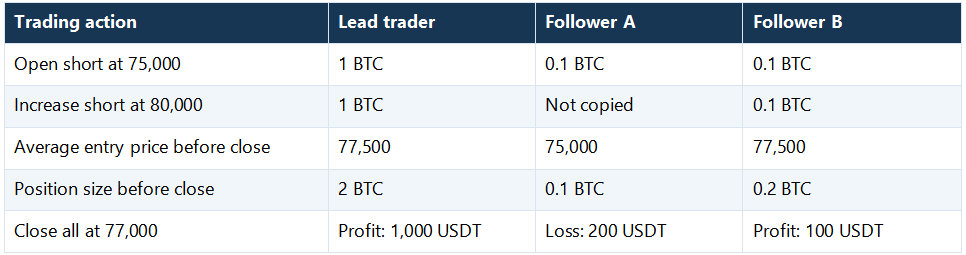
The differences in this example arise from the trades actually executed. Follower A did not participate in the position increase at 80,000 USDT, so their closing profit or loss is still calculated using their own average entry price of 75,000 USDT. Continuing to copy subsequent trades does not necessarily eliminate differences that arose earlier.
4. Orders May Be Delayed, Partially Filled, or Not Filled
When copying position openings or increases, Stockcoin uses immediate-or-cancel (IOC) limit orders: the quantity that can be filled immediately is executed, and the remainder is canceled. If the lead trader uses a limit order, copying is triggered only after that order has been fully filled. Insufficient available margin, minimum trading requirements, position limits, liquidity, and system issues may all affect execution.
Orders to open or increase positions use the lead trader's execution price for that trade as a reference. The maximum slippage limit is fixed at 1% and cannot be changed by users. If the initial attempt fails, the system may retry up to two more times, for a maximum of three attempts in total. The same slippage limit applies to retries. If all attempts fail, the system skips that trade and continues copying subsequent trades. Neither price protection nor retries guarantee execution. A failed order that has been skipped will not be automatically re-executed if you add funds later.
5. Margin Mode and Leverage Affect Your Risk Exposure
Stockcoin AI trading supports cross margin only; isolated margin is not supported. Funds allocated to different lead traders are kept separate. Within the copy-trading portfolio associated with the same lead trader, positions share that portfolio's margin. A loss on one position may therefore affect other positions in the portfolio. Segregation of allocated funds does not protect principal or eliminate market or liquidation risk.
Your average entry price, account balance, leverage, and other open positions may differ from those of the lead trader, so your liquidation price may also differ. The fact that the lead trader has not been liquidated does not mean that your position is safe. The lack of isolated margin alone cannot explain missed copy trades or differences in returns; actual orders and account records must still be reviewed.
6. Take-Profit, Stop-Loss, and Closing Orders May Not Achieve the Expected Result
The trigger conditions for take-profit and stop-loss orders are not the same as their final execution prices. Price gaps, insufficient liquidity, price limits, or service interruptions may cause delays, partial fills, or temporary execution failures. Actual losses may exceed the stop-loss amount or percentage you set.
Stockcoin uses market orders to copy position closings. The 1% slippage protection used for opening or increasing positions does not apply to closings, and your actual closing price may differ significantly from that of the lead trader. If the lead trader closes a position using a limit order, the copied close is triggered only after that order has been fully filled. Partial closings are executed at the same proportion of the corresponding positions in each account: for example, if the lead trader closes 20% of the relevant position, the system will attempt to close 20% of your corresponding position. Review actual fills and remaining positions to verify the outcome.
When you stop copying, you may choose either to continue following the lead trader's position-closing actions or to manage your existing positions yourself. In either case, new position openings and increases will no longer be copied. If you choose to manage positions yourself, you are responsible for doing so. Stopping AI trading does not immediately close existing positions. Market risk and any applicable funding fees continue for as long as those positions remain open.
7. Consider Trading Costs When Evaluating Performance Data
Stockcoin AI trading charges the same trading fees as ordinary derivatives trading. Funding payments on perpetual contracts may be payable or receivable. The lead trader's profit-sharing rate is the rate actually displayed when you begin copying, and settlement occurs weekly. A positive gross trading profit does not necessarily mean that net returns remain positive after trading fees, funding payments, and profit sharing are deducted. Review the applicable fees and profit-sharing rules before enabling AI trading.
Rate of return, realized profit and loss, unrealized profit and loss, and total account assets are different statistical measures. When comparing them, check the measurement period and whether unrealized P&L, fees, deposits, and withdrawals are included. Information shown on pages and in notifications may be delayed; verify it against your trade history, funds records, and remaining positions.
8. Precautions Before and During Use of AI trading
Before activating the feature, confirm that you meet the service's geographic availability and account eligibility requirements. Understand the trading instruments, leverage, and margin rules, and read the applicable agreements. Set an appropriate capital allocation and acceptable risk level, and understand how positions will be handled if a position increase fails, copying is stopped, or an abnormal event occurs.
After activation, continue monitoring available margin, risk indicators, and copy-trading records. If you receive a failure notification or notice that positions are out of sync, investigate the cause first. Simply adding funds or increasing leverage may raise your risk and does not guarantee that your positions will become aligned with those of the lead trader. Users cannot adjust Stockcoin's 1% slippage limit for position openings.
9. Disclaimer and Scope of Liability
This document explains how AI trading operates and the associated risks. It does not constitute investment, legal, tax, or other professional advice, or a guarantee of returns. Displaying lead traders and their trading data does not constitute a recommendation, endorsement, or guarantee of any particular lead trader, strategy, or trade.
You should independently decide whether to use AI trading and, to the extent provided under applicable law and valid agreements, bear the relevant market risks and risks associated with your investment decisions. AI trading does not guarantee profits, successful execution of every trade, uninterrupted service, or trading results identical to those of the lead trader.
Trading issues or disputes concerning losses should be handled with reference to the actual causes, trading records, applicable agreements, and legal requirements. Nothing in this document excludes or limits any liability that cannot be excluded or limited under applicable law, or affects your statutory rights. This document does not cover every possible risk. Please read it together with the applicable service agreements and trading rules for details of specific functions and trading arrangements.