
Hong Kong’s IPO market is entering a period of rapid growth. This article explores why global capital is moving into Hong Kong IPOs, the market’s structural advantages, future opportunities, and the innovative model that enables investors to participate in Hong Kong IPOs using USDT.
Through Stockcoin, a stock trading platform backed by Amber Group, users can participate in Hong Kong IPOs with USDT in one click and easily position themselves in high-quality global new stocks.
In recent years, a mainstream track that used to be underestimated by individual investors, but has been continuously increased by top global capital, is once again becoming the focus: the Hong Kong IPO market.
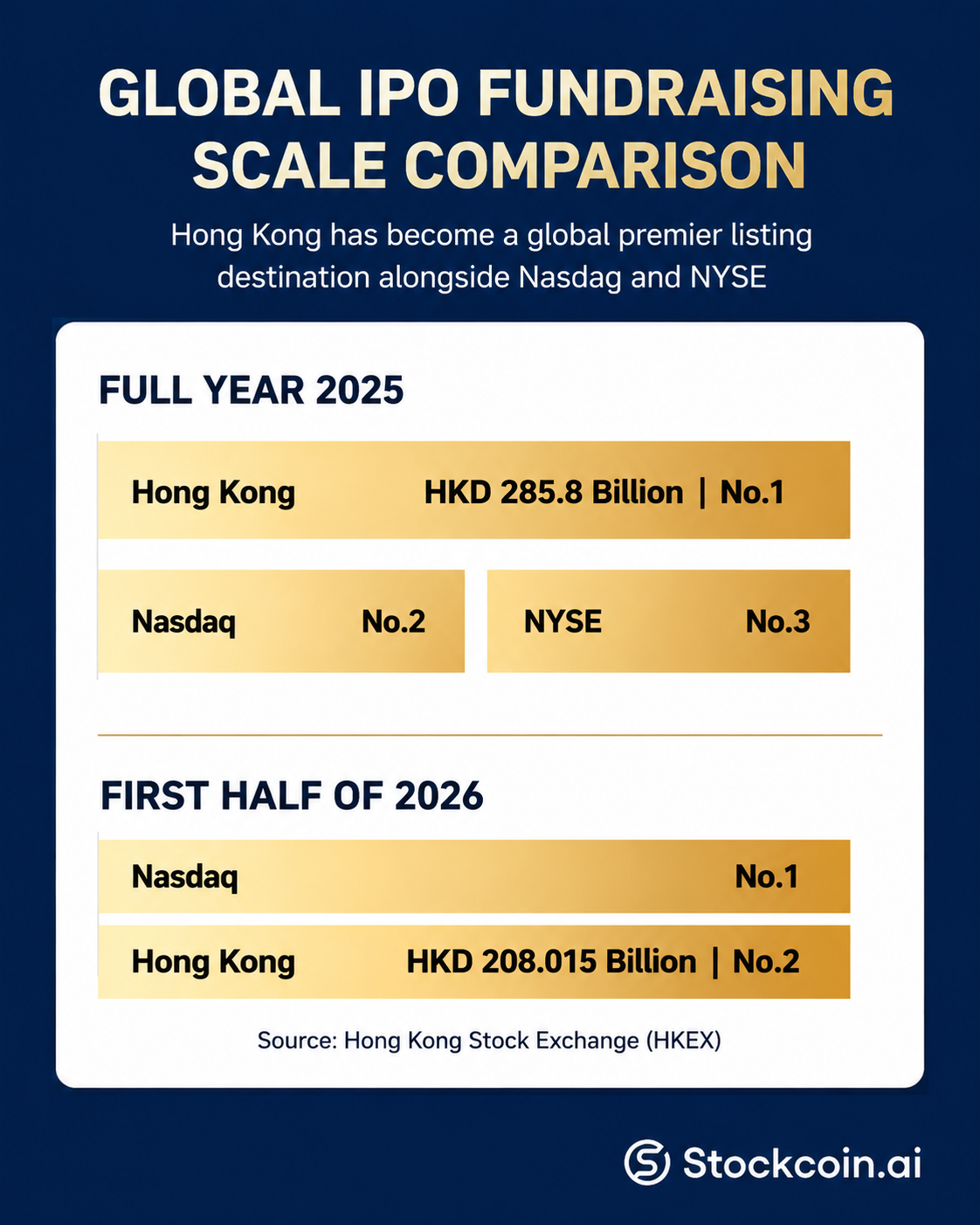
In 2025, Hong Kong ranked first globally in IPO fundraising; in the first half of 2026, Hong Kong continued to hold second place globally, second only to Nasdaq. For global asset management institutions, sovereign wealth funds, family offices and hedge funds, Hong Kong IPOs have long been an important part of cross-market asset allocation.
For ordinary investors, however, this is still a market with an obvious cognition gap and an opportunity window that is opening.
I. Build the Basic Understanding First: What Level of Market Is Hong Kong IPO, Exactly?
Many investors’ impression of Hong Kong is still stuck at “Asian tourism city” and “one of the regional financial centers,” but very few people realize that today’s Hong Kong IPO market is already a top-tier global listing venue on the same level as Nasdaq and the New York Stock Exchange.
This is not industry self-praise, but a real global ranking:
- For the full year of 2025, Hong Kong stock IPO fundraising reached HKD 285.8 billion, surging 225% year on year and directly rising to first place globally;
- In the first half of 2026, 84 new companies were listed, with total fundraising of HKD 208.015 billion, setting a new high for the same period in the past five years. The fundraising scale ranked second globally, second only to Nasdaq;
- The market structure is also undergoing a qualitative change: in the past, Hong Kong stocks were dominated by traditional industries such as finance and real estate. Today, hard-tech companies such as AI foundation models, humanoid robots, semiconductors and biotechnology have become the absolute main force of IPOs.
To give the most intuitive comparison: for high-quality global companies seeking international listings, there are now only three core choices: U.S. stocks (Nasdaq / NYSE), Hong Kong stocks and A-shares. For global investors, Hong Kong stocks are the only market in the world that can simultaneously take into account “China’s growth dividends” and “international regulatory rules” — this is a unique value that Singapore, Tokyo and Seoul do not have.
It is not a niche market in a certain region, but the core hub for global capital to allocate Chinese assets, and a mainstream investment arena on the same level as U.S. stocks.
II. Why Is Global Capital Rushing Into Hong Kong IPOs Now? This Is Not Hype, but an Inevitable Trend Driven by the Resonance of Three Major Cycles
Many people may think that “a hot market is short-term speculation,” but the recovery of Hong Kong stock IPOs in this round is a long-term trend created by the superposition of three major dividends: institutions, capital and hub value. It is a consensus voted by global capital with real money.
1. Institutional dividend: replicating Nasdaq’s rise and opening the gate for hard-tech listings
In the past, the default rule of global capital markets was that companies had to be profitable before they could go public. This directly shut out a large number of early-stage technology companies with high growth and high R&D investment — yet precisely these companies are the ones that can bring investors the highest growth returns.
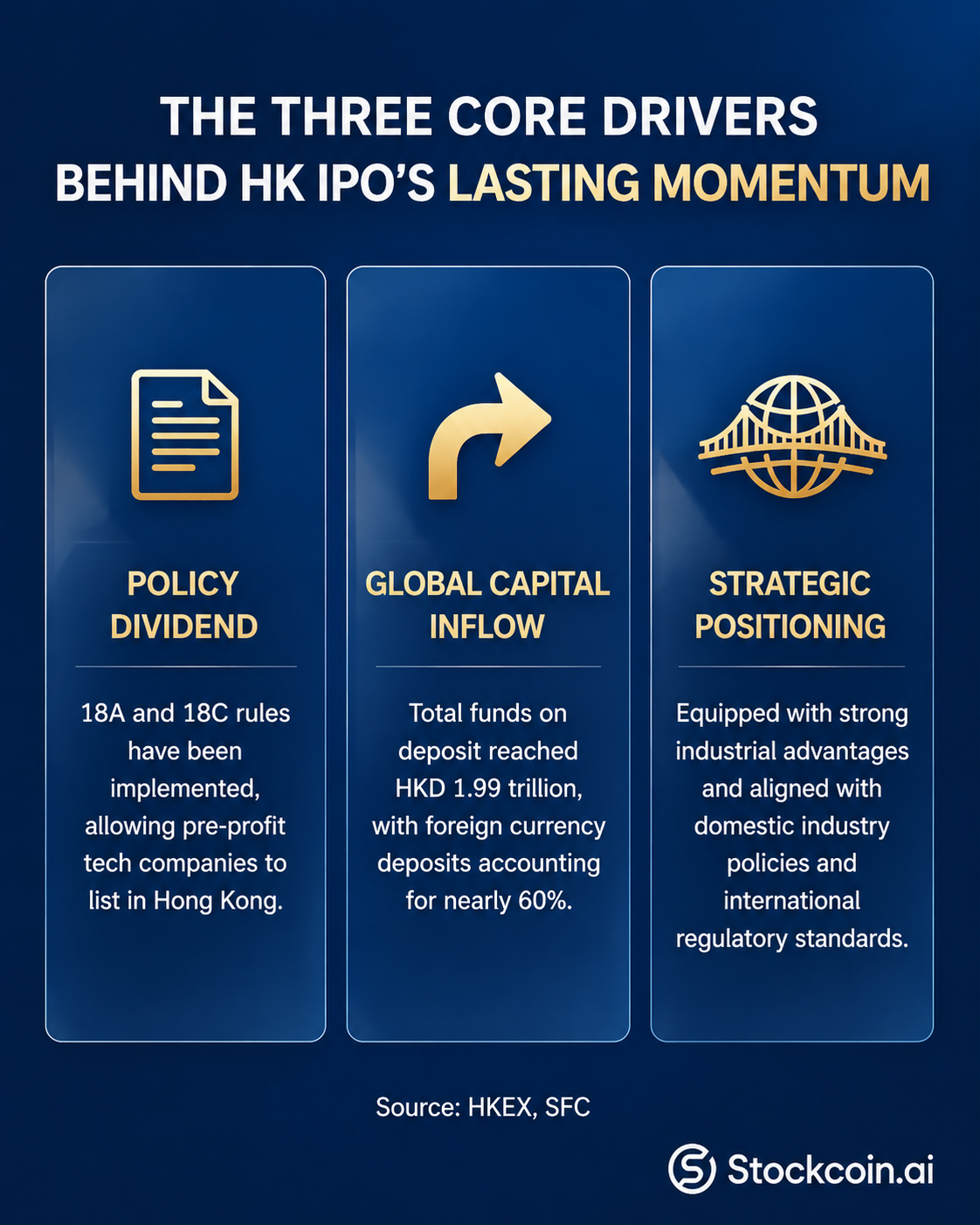
The listing rules successively launched by HKEX, including 18A (pre-profit biotechnology) and 18C (specialist technology), have completely broken this limitation: companies in the five major fields of AI, semiconductors, humanoid robots, new energy and biotechnology do not need to meet profitability standards. As long as they meet the requirements for R&D investment, technological barriers and revenue scale, they can list and raise funds.
This is completely consistent with the logic of Nasdaq’s rise back then: using an inclusive system to attract the world’s most promising technology companies, and then forming a positive cycle of “quality companies attracting capital → capital flowing in and giving birth to more quality companies.” Today, for global hard-tech entrepreneurs seeking international listings, Hong Kong has already become a preferred destination alongside Nasdaq.
For investors, this means you can enter during the early stage of a company’s growth and share the excess returns from “startup to industry leader,” instead of waiting until the company is mature and its valuation has peaked before taking over at a high level.
2. Capital cycle: under the global wave of rate cuts, capital is overflowing from high levels and flowing into value depressions
The Federal Reserve’s rate-cut cycle has already begun, and U.S. dollar liquidity continues to loosen. But U.S. stocks have experienced a multi-year bull market, and overall valuations are at historical highs. The room for further upside is limited, while the risk of high-level pullbacks continues to accumulate.
Global large capital needs to look for new value depressions — markets with sufficiently low valuations, strong growth certainty, compliant and transparent markets, and free capital inflows and outflows. Hong Kong happens to perfectly match all these requirements:
- After the deep adjustment of the past few years, the overall valuation of Hong Kong stocks is at a historical low, with a sufficient safety cushion;
- Backed by China, the world’s largest consumer market and the most complete manufacturing industry chain, companies have an extremely high growth ceiling;
- Capital can enter and exit completely freely, regulatory rules are fully aligned with international standards, and foreign investors do not need to adapt to localized rules.
The data best illustrates the direction of capital flows: as of April 2026, total deposits in Hong Kong’s banking system had reached HKD 19.9 trillion, of which foreign-currency deposits accounted for nearly 60%. Middle Eastern sovereign wealth funds, European and American pension funds, and Southeast Asian family offices are all allocating Chinese assets in batches through Hong Kong. For large capital pools of tens of billions or hundreds of billions, IPO subscription is the entry method with the lowest risk and the most certain returns.
3. Hub value: the dual attributes of “China market + international rules” cannot be replicated by other markets
People often ask: aren’t Singapore and Tokyo also Asian financial centers? Why does global capital specifically choose Hong Kong?
There is only one core answer: only Hong Kong can simultaneously achieve “seamless connection with the Chinese market” and “complete alignment with international rules.”
- At the rules level: Hong Kong uses the common-law system, capital can enter and exit freely, and accounting standards and regulatory standards are fully consistent with global standards. International investors do not need to adapt to any localized rules;
- At the market level: Hong Kong is the global gateway for Chinese assets — more than 70% of international investors’ investment in mainland Chinese stocks is completed through Hong Kong; 60% of investment in mainland Chinese bonds is also conducted through Hong Kong channels.
Although Singapore is also internationalized, it lacks the industrial and market support of China’s hinterland, so the growth ceiling of listed targets is limited; the Tokyo market is relatively closed, foreign participation is low, and local companies lack internationalization.
This unique hub position determines the long-term value of the Hong Kong IPO market. It is not short-term market hype, but an inevitable choice in global asset allocation.
III. Outlook for the Second Half: 500+ Companies Waiting in Line, and High Prosperity for the Full Year Is Already Set
The underlying logic of the resonance of the three major cycles supported the hot performance of Hong Kong stock IPOs in the first half. What more investors care about is: how long will this wave last? Will entering now mean missing the best timing? Judging from the current market reserves and forecasts from authoritative global institutions, the prosperity of this round of Hong Kong stock IPOs is far from the top. In the second half of 2026, the market will continue its hot trend and may even enter a more intensive issuance period of high-quality targets.
1. Sufficient reserves: more than 500 applications waiting in line, setting a new historical high
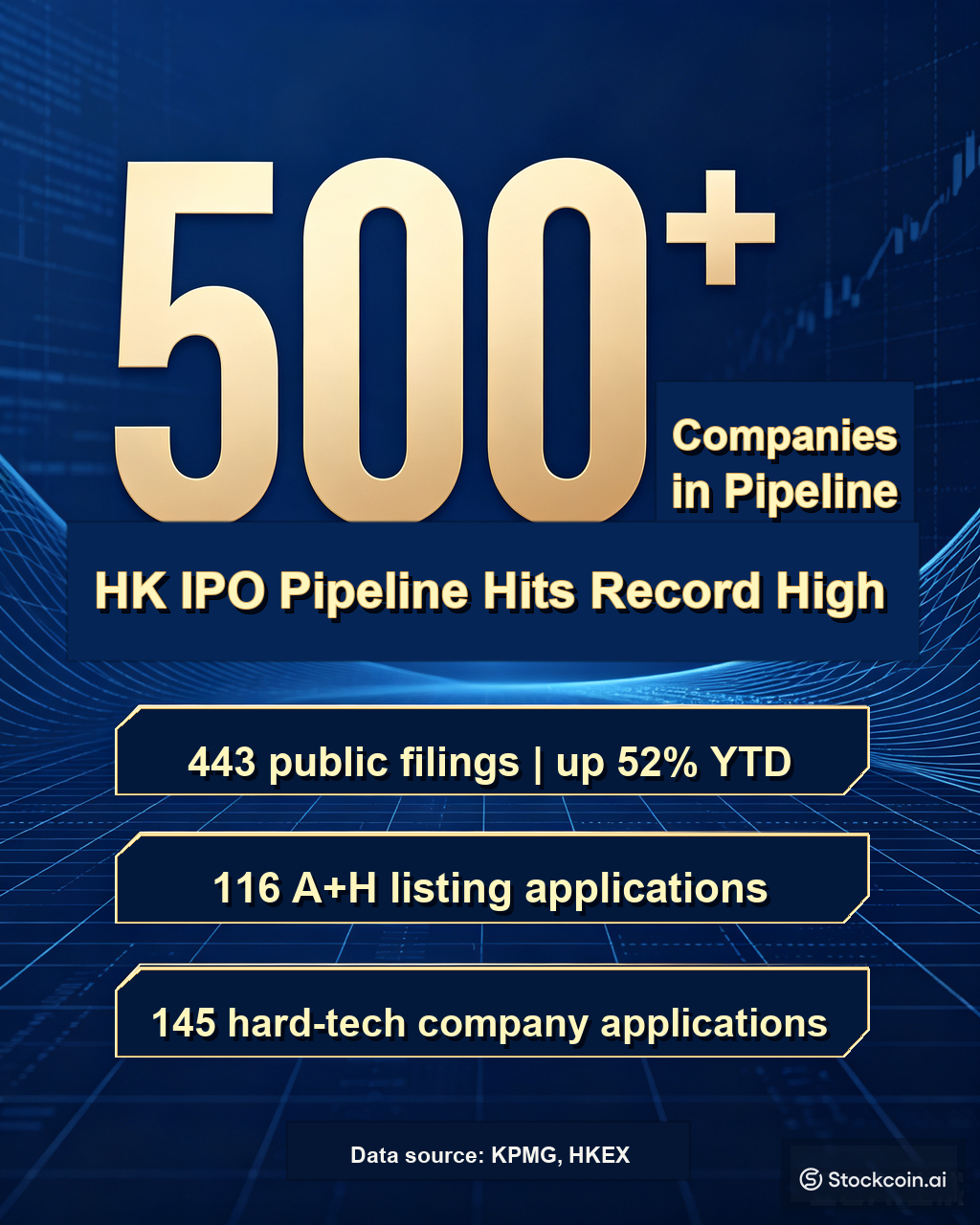
According to statistics from Hong Kong Exchanges and Clearing and KPMG, the number of listing applications currently being processed by the Hong Kong stock market, including confidential filings by companies, has exceeded 500, setting a new historical high; among them, publicly submitted listing applications have reached 443, a sharp increase of 52% from the beginning of the year. The huge reserve of companies in line provides sufficient supply guarantee for the IPO market in the second half, and there will not be a blank period with no new stocks to subscribe to. For ordinary investors, this means there will be continuous IPO subscription opportunities in the second half, rather than a one-off short-term market trend.
2. High-quality fundamentals: technology and leading companies account for a high proportion, and track value is prominent
What deserves even more attention is the quality of the companies in line — they are precisely the high-growth tracks most sought after by global capital, and they form the main force of IPOs in the second half:
- In terms of company type, there are 116 “A+H” listing applications (that is, industry-leading companies listed in both mainland China and Hong Kong), as well as 145 technology-company listing applications;
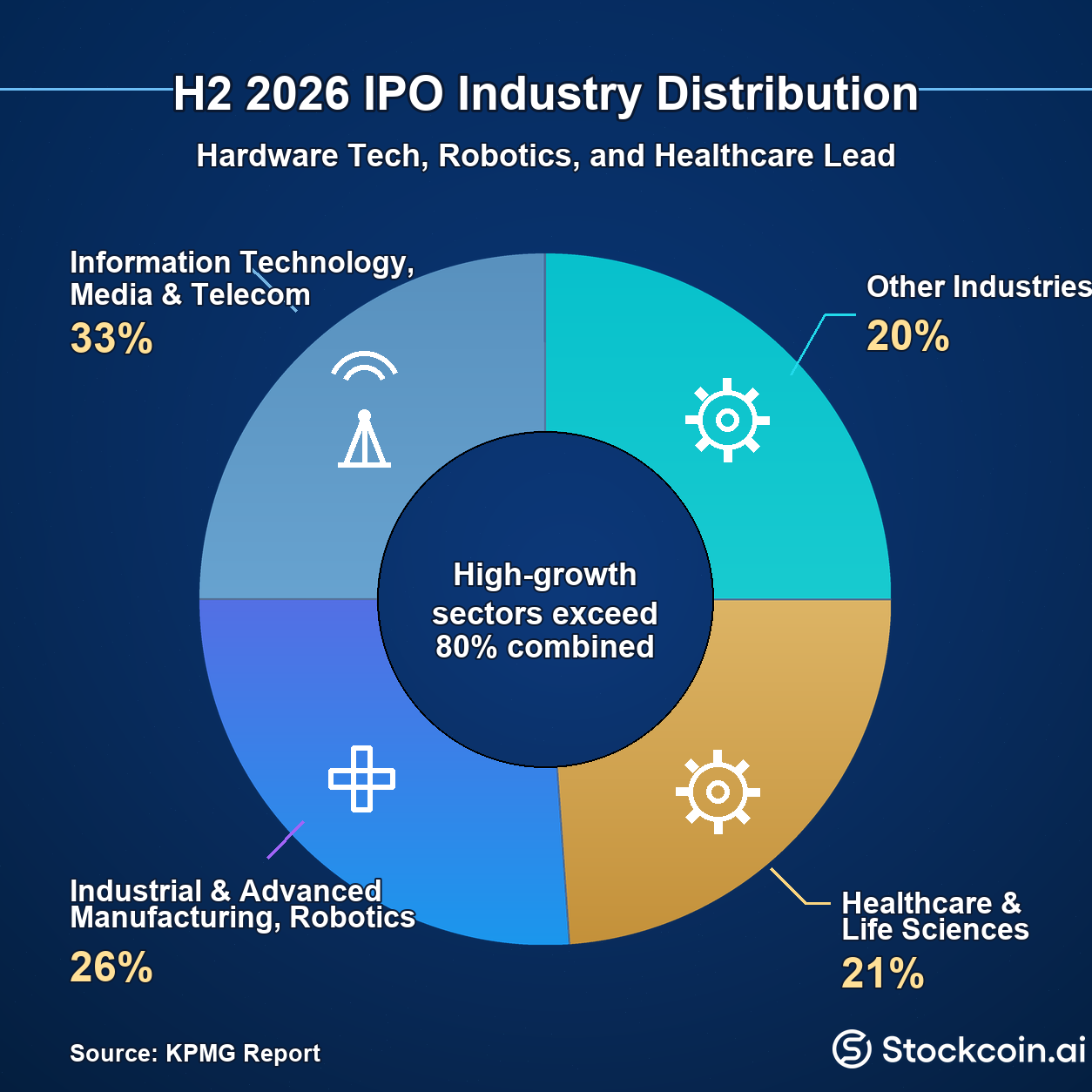
- In terms of industry distribution, information technology, media and telecommunications account for 33%; industrial and advanced manufacturing (including robotics and automation) account for 26%; healthcare and life sciences account for 21%. The three high-growth tracks together account for more than 80%.
This means that the new stocks listed in the second half will not only be large in quantity, but will also have stronger growth attributes. In particular, 18C specialist technology companies and “A+H” leading companies will become the main sources of fundraising in the second half. Among them, the number of “A+H” share listings in Hong Kong in 2026 is even expected to set a new historical high, continuously strengthening the profit effect of Hong Kong stock IPOs.
3. Institutional consensus: full-year fundraising is expected to exceed HKD 300 billion, and high prosperity continues
For the Hong Kong stock IPO market in the full year of 2026, many authoritative institutions around the world have given clear optimistic expectations:
- The latest reports from Deloitte and EY both expect that the number of new Hong Kong stocks in 2026 is expected to reach 160, and full-year fundraising may reach HKD 300 billion to HKD 320 billion;
- The optimistic expectation given by Eddid Securities and Futures shows that the number of IPOs in 2026 is expected to reach 150, and the total financing amount could reach as high as HKD 350 billion;
- CITIC Securities also pointed out that the current number of Hong Kong stock IPO filings and companies in the queue are both at high levels in recent years. Under dual support, the market will continue to maintain high prosperity throughout 2026.
Louis Lau, Partner in charge of Capital Markets at KPMG China Hong Kong, also publicly stated: “Benefiting from active IPO market activities and a large number of IPO applications, we are optimistic about the prospects of the Hong Kong IPO market.”
Simply put, the heat of Hong Kong stock IPOs is not a short-term pulse market, but a long-term trend supported by sufficient supply, high-quality targets and global institutional consensus. For investors, entering now is not too late. On the contrary, the market is still in its first half, and there will be more high-quality targets in the second half bringing continuous IPO subscription dividends.
IV. For Ordinary Investors, How Strong Is the Profit Effect of Hong Kong IPOs?
After discussing macro trends and future outlook, we ultimately need to return to the question investors care about most: if I participate in Hong Kong stock IPOs, can I make money?
1. Return elasticity: far exceeding U.S. IPO subscription
In the first half of 2026, the average first-day gain of Hong Kong specialist technology company IPOs significantly led global mainstream markets, and the highest first-day gains of leading AI and humanoid robot targets exceeded 120%. The return elasticity of Hong Kong stock IPO subscription is several times that of mature markets.
Such high returns are not hype: most of the listed companies are in a high-speed growth stage, their valuations have not yet been fully priced at listing, and with global capital continuously flowing in, the room for valuation repair after listing is naturally huge. For investors, this is the typical dual return of “earning company growth + valuation repair.”
2. Friendly allotment: a retail-priority mechanism, where small subscriptions can also win allocation
Unlike U.S. IPOs, where most shares are allocated to institutions and retail investors can only “rely on luck and compete for an extremely low probability,” Hong Kong IPOs have a clear retail-priority allocation mechanism: the shares in public offerings are tilted toward retail investors with smaller subscription amounts, and the lower the subscription amount, the relatively higher the probability of winning allocation.
In other words, you do not need to prepare a large amount of capital to gamble on luck. Small subscriptions also have a high probability of winning allocation, truly allowing ordinary investors to share in the dividends of the primary market in a tangible way, instead of only watching institutions make money.
3. Sufficient liquidity: after making a profit, you can sell at any time without worrying about being trapped
Many people worry that “new stocks rise but cannot be sold.” In the Hong Kong stock market, there is no need to worry about this at all. Hong Kong is one of the capital markets with the best liquidity in the world. After new stocks are listed, trading is active. As long as you want to sell, you can complete a transaction at any time, and funds can be recovered quickly. There is absolutely no liquidity risk of “having a price but no market.”
V. Differentiated Advantage: Users Can Participate by Holding USDT, Completely Solving the Pain Points of Traditional IPO Subscription
1. This is not a gray operation, but a compliant innovation supported by Hong Kong officials
Many users have compliance concerns about crypto-related investments, but this point can be fully reassured. RWA is a mainstream development trend in global fintech. In its “Fintech 2030” strategy, the Hong Kong Monetary Authority clearly listed financial tokenization as one of the four core development directions, with a clear regulatory framework and clear policy support.
The specific operating logic is very transparent: real IPO new-share interests are mapped into digital asset interests through a compliant structure. The underlying layer corresponds 100% to real new-share assets, and licensed Hong Kong custodians conduct dual supervision of assets and funds. The entire process is traceable, and investors’ shares and income rights are fully protected by Hong Kong law.
Hong Kong’s fintech competitiveness currently ranks first in the world. This innovative model is already very mature and is a mainstream direction that the global asset management industry is following.
2. For users, the four core benefits of using USDT for IPO subscription
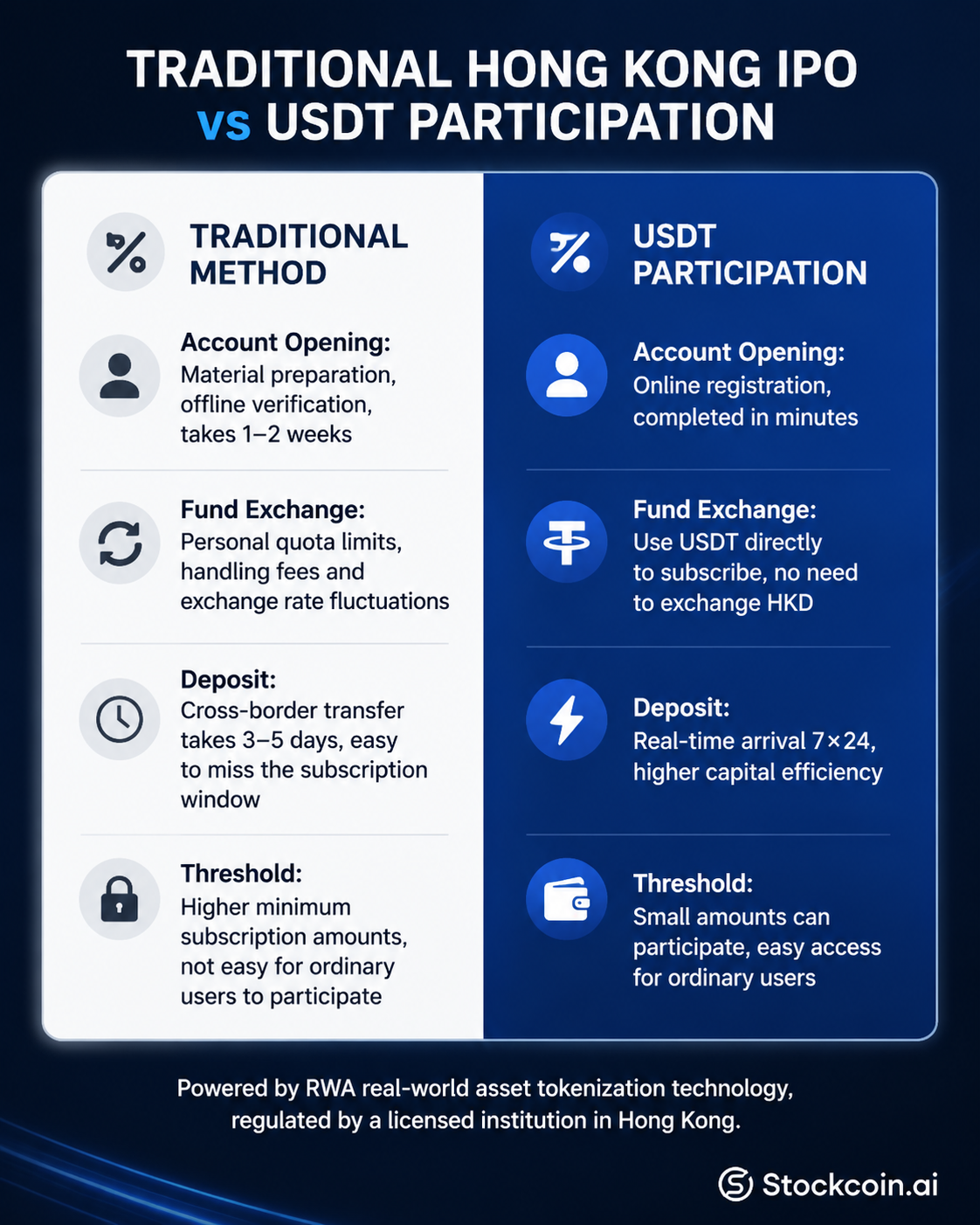
- Zero-threshold account opening: no Hong Kong securities account is required, and no overseas bank account is required. You only need to register a platform account and complete identity verification to participate. The entire process is online, can be completed in a few minutes, and has no cumbersome material requirements;
- No foreign-exchange costs or restrictions: directly use USDT for subscription and settlement, with no need to exchange into Hong Kong dollars or U.S. dollars, completely free from personal foreign-exchange quota restrictions, and no need to worry about exchange-rate fluctuations eroding investment returns;
- Real-time and efficient funds: USDT transfers support 24/7 real-time arrival. You can deposit funds at any time when you want to subscribe, and after selling, funds can be returned immediately. Capital utilization efficiency is several times higher than traditional methods, and you will no longer miss IPO windows;
- Extremely low participation threshold: the minimum subscription amount is far lower than traditional Hong Kong stock IPO subscription. Ordinary users holding USDT can easily participate, with no need to prepare large capital. A small amount can be used to position in popular IPO targets.
VI. Stockcoin: The Preferred Platform for Users to Participate in Hong Kong IPOs
Stockcoin is a professional platform focused on compliant Hong Kong RWA assets and primary-market services. It is committed to enabling global investors to participate in the dividends of Hong Kong IPOs with low barriers and convenience.
By choosing Stockcoin, you will receive:
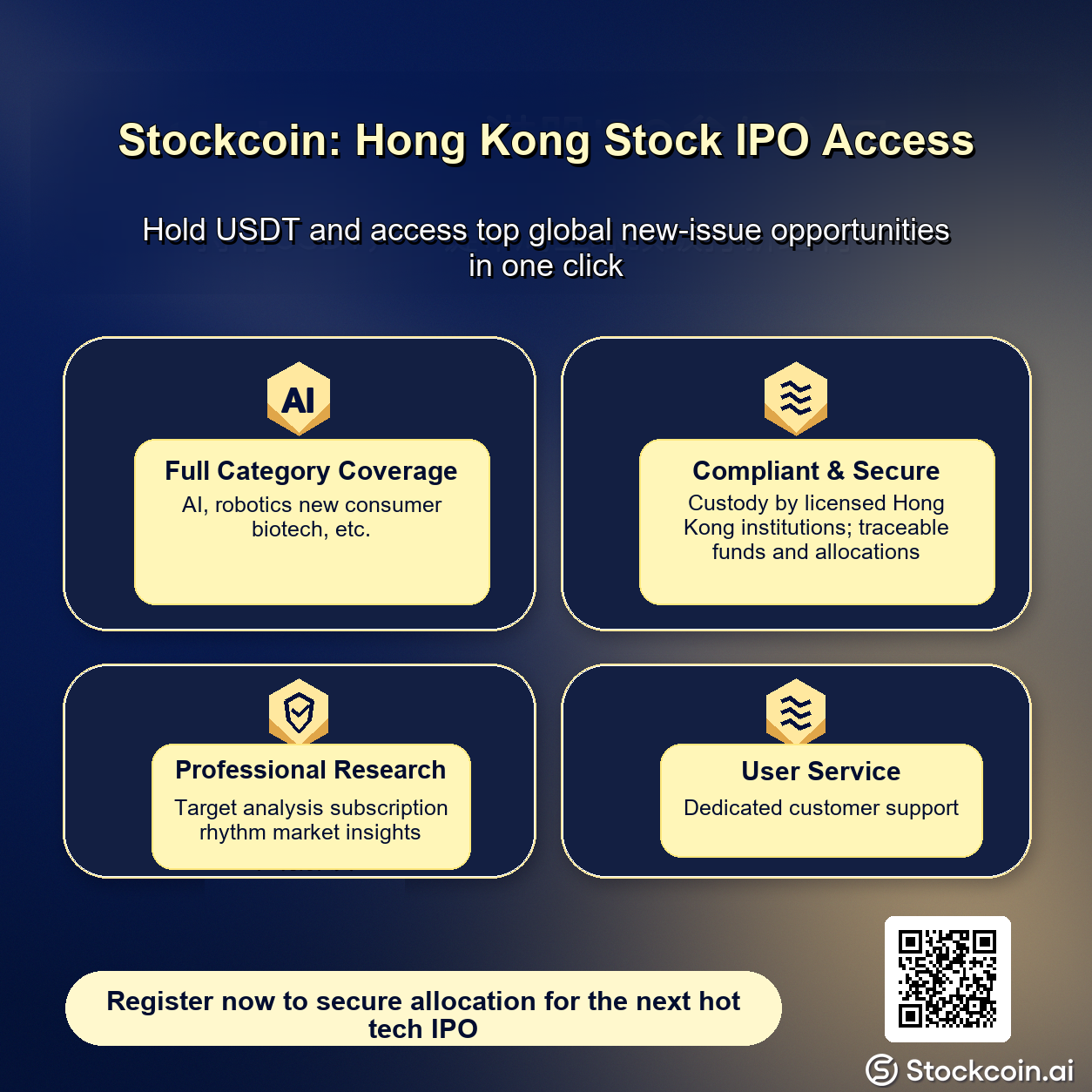
✅ Full-category coverage of popular targets: synchronizing all high-quality IPO projects on HKEX, covering all popular tracks such as AI foundation models, humanoid robots, new consumption, biotechnology and semiconductors, so you do not miss any IPO opportunity during the intensive issuance period in the second half;
✅ Dual compliance and security protection: underlying assets are supervised by licensed Hong Kong custodians, funds and shares are traceable throughout the whole process, Hong Kong financial regulatory requirements are strictly followed, and investor rights and interests are protected throughout the process;
✅ Professional investment research throughout the whole process: a senior financial investment research team provides in-depth target analysis, market interpretation and subscription recommendations. Even if this is your first time coming into contact with Hong Kong stock IPOs, you can quickly get started and make rational investment decisions;
✅ User-friendly service: the operation process is optimized for users, with dedicated customer service and other support, making the entire journey from registration to subscription barrier-free.
In 2026, Hong Kong IPOs are becoming a standard allocation asset for global investors. Without going to Hong Kong, without foreign exchange, and without opening an overseas account, holding USDT allows you to position yourself in the IPO subscription dividends of a top global market in one click. Register on Stockcoin now, immediately lock in subscription quotas for the next batch of popular hard-tech IPOs, and seize the core growth opportunity of this round of global capital markets.